Note market data
How mortgage rates affect what your note is worth
Latest: 30-year fixed mortgage rate 7.32% (week ending Oct 22, 2026); 10-year Treasury yield 4.96% (Oct 22, 2026). Source: FRED.
Hold a note? Ask for a no-obligation note review. If it fits, we'll introduce you to note buyers who may make an offer.
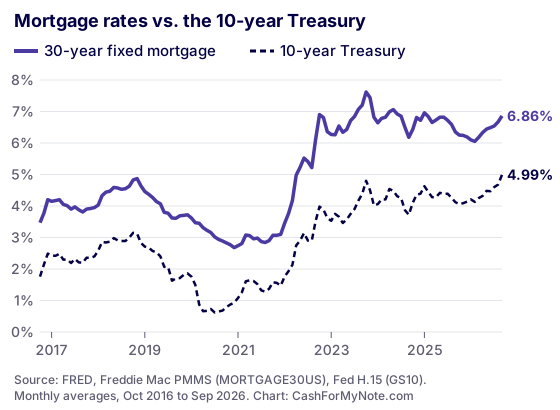
30-year mortgage rate vs. 10-year Treasury yield, 10 years
Download: SVGPNGMonthly data (CSV)
Related data: homes with a mortgage by state, showing where owners with no mortgage live.
Latest values
| Measure | Value | Data date |
|---|---|---|
| 30-year fixed mortgage rate, weekly | 7.32% | Week ending Oct 22, 2026 |
| 10-year Treasury yield, daily | 4.96% | Oct 22, 2026 |
| 30-year fixed mortgage rate, monthly average | 6.86% | September 2026 |
| 10-year Treasury yield, monthly average | 4.99% | September 2026 |
| Gap between the two (monthly averages) | 1.87 points | September 2026 |
| 30-year rate ten years earlier, monthly average | 3.47% | October 2016 |
Source: FRED (MORTGAGE30US weekly, DGS10 daily, GS10 monthly); data dates in the table. Gap = 30-year minus 10-year monthly average.
What the data shows
- Over these ten years, the 30-year fixed rate's monthly average was lowest in December 2020, at 2.68%, and highest in October 2023, at 7.62%.
- The 10-year Treasury yield's monthly average ranged from 0.62% in July 2020 to 4.99% in September 2026.
- The two lines tend to move together. The gap between them was 1.87 points in September 2026. Over the ten years it ranged from 1.34 points (May 2021) to 2.96 points (June 2023).
How rates, yield and spread fit together
- Yield is the return a buyer earns. It depends on the price paid and the payments collected.
- Market rates are what money earns elsewhere. The 10-year Treasury yield and the 30-year fixed mortgage rate are two common yardsticks.
- Spread is the extra yield a buyer wants above a yardstick like that, for the risk and work of a private note.
- Your note's rate is fixed. It sets the payments, and those don't move when markets move.
Put together: the yield a buyer wants is roughly a market rate plus a spread. When market rates go up, that target usually goes up, and the price that delivers it on the same fixed payments goes down. When market rates go down, the reverse usually happens. For the math behind this, see how mortgage notes are priced.
Hypothetical example: Two notes are the same in every way: same balance, same fixed rate, same borrower record. One is offered to buyers in a year when market rates are low. The other is offered in a year when market rates are higher. The second buyer wants a higher yield to keep up with what money earns elsewhere. The payments are the same, so that buyer gets the higher yield by paying a lower price.
What this means if you hold a note
- Your payments don't change. A fixed-rate note pays what it says, whatever happens to market rates.
- What a buyer will pay can change. Buyers set their target yield against market rates, so the same note can draw different offers in different rate climates.
- Your note's rate compared with today's rates matters. A note written at a rate well below current market rates usually sells at a deeper discount than one written at a rate near or above them.
- Rates are one factor, not the whole story. Payment history, equity, lien position, the borrower and the paperwork often matter more. See note buyers for what they look at.
- No one can time rates for you. This page shows past data only. It doesn't predict where rates go next.
Want to see what buyers say about your note today? Ask for a no-obligation note review. If it fits, we'll introduce you to note buyers who may make an offer. You can also test the math first in the note value estimator.
Questions
Why do higher market rates lower what a note buyer will pay?
A buyer compares your note with what the same money could earn elsewhere. When market rates rise, the buyer wants a higher yield. Your note's payments are fixed, so the only way to get a higher yield from the same payments is to pay a lower price.
Do falling rates raise the price of my note?
Usually, yes, other things being equal. When market rates fall, buyers will often accept a lower yield, and a lower yield on the same payments means a higher price. Payment history, equity and paperwork still matter as much as rates.
Does my note's interest rate change when market rates change?
Not for a fixed-rate note. The rate, payment and schedule stay as written. What changes is how that fixed stream of payments compares with new loans and bonds, and so what a buyer will pay for it.
What is the spread?
Here it means the gap between two rates. On this page it is the 30-year fixed mortgage rate minus the 10-year Treasury yield. Note buyers also think in spreads: the extra yield they want above a benchmark for the risk and work of a private note.
Which rate should I watch?
The 10-year Treasury yield and the 30-year fixed mortgage rate are widely used benchmarks, and both are on this page. No single rate sets the price of a private note. Each buyer sets its own target yield.
Should I wait for rates to fall before I sell?
Nobody can tell you where rates will go next, and this page makes no forecast. Rates are one factor among many. A no-obligation note review shows what buyers say about your note today.
Where does this data come from?
The 30-year rate is Freddie Mac's Primary Mortgage Market Survey. The 10-year yield is the Federal Reserve's H.15 release. Both were downloaded from FRED, the Federal Reserve Bank of St. Louis database, on Oct 24, 2026.
Embed this chart
Sources and notes
- 30-year rate: Freddie Mac, 30-Year Fixed Rate Mortgage Average in the United States, MORTGAGE30US, weekly, retrieved from FRED, Federal Reserve Bank of St. Louis, on Oct 24, 2026. Monthly figures are FRED's average of the weekly readings in each month. Freddie Mac changed the survey's method on November 17, 2022; it now uses applications submitted to Freddie Mac by lenders.
- 10-year yield: Board of Governors of the Federal Reserve System, H.15, 10-year Treasury constant maturity, monthly average (GS10) and daily (DGS10), retrieved from FRED on Oct 24, 2026.
- Gap = 30-year monthly average minus 10-year monthly average, in percentage points, worked out from the two FRED series. The chart and gap use only months where both monthly averages are published, so the latest month is September 2026.
- This page refreshes monthly from the FRED API.
Curious what your note could bring today?
Answer a few quick questions for a no-obligation review. If it fits, we'll introduce you to note buyers who may make an offer.
Ask for a no-obligation note reviewRelated
- How mortgage notes are priced
- Homes with a mortgage by state
- Note value estimator
- How to sell a mortgage note
Educational information only, not legal, tax or investment advice. The data describes the past. It is not a forecast, and it is not a price or offer for any note. CashForMyNote.com does not buy notes. Affiliate disclosure.